Picking and Blocking

Any picking or strumming method that exists for regular guitar can be applied to playing lap-style.
As such, any tutorial for guitar right-hand technique can be easily adapted for the Steel guitar.

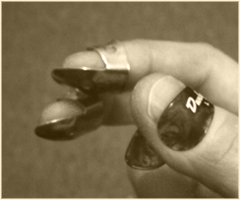
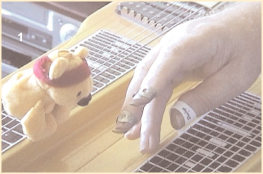
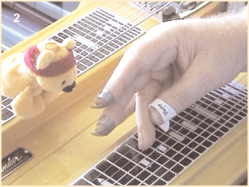
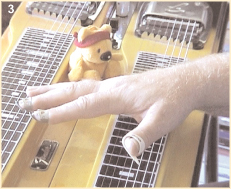
Traditionally, Steel Guitar is played using a thumbpick and 2 fingerpicks.
By using picks you will get more volume & better projection with a crisper attack.


There are players out there who happily use no picks at all, just a thumbpick, a combination of picks & fingernails, or even a regular guitar plectrum or "flatpick".

It pays to experiment, your choice of picking method will be determined by the style of music you want to play, and what sounds/feels good to you.
However you choose to pick, be sure to stay relaxed and let your ear-to-hand coordination find and develop all the subtle nuances of the instrument's voice.

If you play fingerstyle, with or without picks, much knowledge can be gained by raiding online Dobro or Banjo picking / right-hand-technique tutorials...


No Picks

Playing without picks a distinctive and often very "intimate" tone and suits a gentle playing style...

If you try to play loud for long enough you'll get sore fingers!

You should build calluses on your fingertips if you regularly for long enough using this method, some recommend dabbing surgical spirit on there after playing to help toughen the skin.
If you do cultivate some good callusses, avoid playing after having had your hands immersed in water for a long time, as they will be destroyed!


Thumbpick & Bare Fingers

Playing with a thumbpick makes it easier for alternating/constant bassline playing.
The different angle of your hand when using a thumbpick means it's easier to control the muting of the lower strings with the palm/heel of the hand, leaving the fingers free to explore melody lines or add tonal colour to the chord progression, or implying chords alongside the bass.

There can be a distinct difference of tone/volume between the thumb & fingers using this method, but this can be overcome with practice & perseverance.
When playing runs using the thumbpick, you can make alternate ( up & down-stroke ) picking easier by steadying the thumbpick with your index finger, as you would hold a regular plectrum.

Flatpick

Using a regular guitar plectrum is also an option, picking and strumming as usual, or using the remaining finger(s) for "chicken-pickin" licks.

You could also try using fingerpicks on any of the remaining fingers.

Thumbpick & Fingernails

This achieves a much louder sound with crisper attack than when using the fleshy pad of the fingertips.

You must be able to grow nails strong enough, which relies on your diet & genetic makeup, growing & keeping them in good condition can be tricky!
Some players use stick-on plastic nails for convenience or necessity!


Pick Material & "Gauge"

Picks can be made from metal or plastic, and come in different gauges ( thickness/stiffness or "weight".)
Everyone has their own preferance for type of picks, depending on the playing style & tone being sought.
Whatever pick you choose, you'll need to customize the fit, so they don't slip off or cause pain by being too tight.
For metal picks, just bend 'em, use pliers if you need to.
For plastic picks, dunk the bent part in some freshly boiled water ( don't burn yourself! ) bend them to the required shape & as they cool they'll "set" in the new position.

Thumbpick & Fingerpicks

Fingerpicks can feel a little unweildy at first, but you'll get a loud & clear tone with crisp attack.

Some people experience excessive pick-noise, a distracting click or tap when the note is struck.
There's various ways of dealing with this, some will meticulously bend the picks so the tip strikes the string without scraping, some just "get on with it" & it kinda goes away with subtle adaptation of technique, or becomes incorporated into the sound.
Slightly rotating the picks on the fingertips so that the tips hit the strings straighter works for me, and is a lot easier than tedious bending!


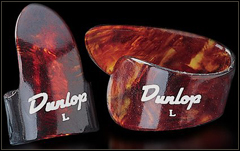
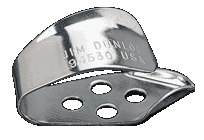
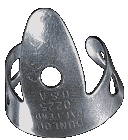
Dunlop Classic "Tortoiseshell" plastic and Metal Thumb & Fingerpicks


Picking Techniques

No matter what you pick with, how & where along the string you pick your note will have a pronounced effect.

Picking closer to the string centre ( halfway between the bridge and the bar, fret12 for an open string ) will get a fuller, bassier sound; pick closer to the bridge for a brighter "twang".

Picking force or "authority" does not only control volume, but tone as well.

Developing and exploring different picking techniques gives you access to the many voices of the Hollowneck, from soulfully deep and profound through to brash lap piano honk if desired!

Alternating/Constant Thumb

When you're playing solo tunes with a "Bluegrassy" feel you'll probably want to develop the solid thumb rhythm technique.
This gives a nice "full band sound" like there's more than one guitar playing.
The thumb plays a constant accompanyment of the bassline while the fingers play a melody-line or note-groups to imply the chord progression seemingly independantly over the top.

This can be frustrating to learn at first... it's easy to get hung up on trying to make your fingers play something seperate from what your thumb is doing.

The first step is to get a truly solid thumb rhythm on it's own.
Just practice alternating the 6th & 4th or 6th & 5th string one after the other while tapping your foot along.
Once you've got that down it's time to learn "the trick"...

Basically the trick is to not think of what your fingers are doing as being "seperate" or "independant" from what your thumb is doing...
Instead think of the finger-stroke as being either "with" or "between" what your thumb is doing.

"Anchoring The Pinky"

This is a technique for steadying the picking hand by resting the tip of the little finger ( or "pinky" as our friends across the pond like to call it ) onto the guitar-top.
Sometimes the 3rd finger is used too.

This can be a useful method, but is considered an absolute "No-No" in the world of "Classical/Spanish/Flamenco" guitar-playing.
Because of this, some acoustic fingerstyle players do frown upon the technique.

In some cases, it can become a bad habit and have a negative effect, causing the picking-hand to become tense and begin pressing down on the guitar with the anchor-finger/s... so be mindful of this if you do find yourself steadying your picking hand in this way.


Harmonics

Mastering the playing of harmonics opens up a whole new range of an acoustic steel guitar's voice...
A "normally" plucked guitar string sounds other quieter & more subtle notes along with the one we hear and identify as the "main note" or "fundamental".
These notes are "harmonics" and are what gives a guitar's sound what we'd call "richness".
When we talk about playing harmonics on a guitar, we mean the act of sounding one of these "extra notes" rather than the fundamental one that we'd normally hear.
If you think of hitting a note on a guitar as being like a human voice singing a note, then harmonics are akin to a sweet "falsetto", but without the comedic "Bee-Gees" association.
A correctly played artificial harmonic on an acoustic steel guitar results in an ethereal chiming sound. These "chimes" are an intrinsic part of Hawaiian Music, but can be utilised in whatever genre of music you're playing, as a special effect or just to gain access to a much higher note than would normally sound out at a given bar-position.

The trick is to momentarily touch a "harmonic node" of a ringing string, forcing it to vibrate at a multiple of it's natural frequency, hence the name "artificial harmonics".
The node-position to create a harmonic that's an octave above the fundamental is exactly half-way along a string's vibrating length, basically doubling the frequency.

It's relatively easy to sound a harmonic on an open string...
Just lightly "dab" your bar-hand's 4th fingertip onto the string exactly above the 12th-fret-marker, at the same instant that you strike the string with your pick.
Experiment to find the other node positions for creating even higher harmonics.

( There's a nice trick you can apply to a single-string open 12th-fret harmonic which goes like this:
When the harmonic's ringing, apply the bar to that string just behind the nut & smoothly slide the bar onto the ringing string, raising the pitch of your harmonic by the desired amount. )

Use the edge of your 4th finger to dab more than one string if you're going for a harmonic on more than one string at a time.
A swift strum-motion with the picking hand can ring a full chord of harmonics at once using this method.

Sounding a harmonic from a barred string is trickier and involves using part of the picking hand to create the node...

The following is reproduced from an article in "Aloha Dream" Magazine, in which Basil Henriques explains how to coax harmonics from a Steel Guitar.
He demonstrates this technique on a twin-neck Fender electric Steel Guitar, but the same method applies for acoustic steel guitar...

Of the many ways to play "artificial Harmonics" I will only explain the more usable ones. The easiest way to practice these methods is at the 12th fret to start with, using "Open" strings.

1. Finger Harmonics (Picked).

With the third finger resting on the front of the string (at the exact octave above the bar position,) and the thumb pick resting behind the string, a twisting motion is applied (finger towards you thumb away).

2. Finger Harmonics (Brushed).

With the thumb positioned between the first and second joints on the underside of the third finger, brush across the strings with the thumb pick slightly ahead of the TIP of the finger... the finger contact witht e string is VERY light.
Again the tip of the finger is positioned at the EXACT octave of the bar position.

3. Palm Harmonics.

With the hand splayed, bounce the HEEL of the palm off the strings whilst plucking the strings with the thumb... DO NOT move the thumb independently... it should be at 90 degrees with regard to the palm, which should be at the octave position as usual.


Blocking Techniques

There's an old saying that goes "Music is what happens between the notes."
It can be important to leave space in what you're playing, in the same way that speech has pauses in it in order to be more understandable & meaningful.

You must take control of the instrument's voice with a firm yet gentle hand.
This comes with practice, and various methods are employed, using both right and left hands.

Palm-Blocking

In regular guitar playing, you have what's called "Palm-Muting", a technique familiar to many, and a useful one on the Steel Guitar also; when playing fingerstyle this is much easier with a thumbpick.
This is where the fleshy "heel" of your picking hand rests on the strings just on or slightly above the bridge saddle.
Vary the pressure & position to get a different tone and sustain.


If you practice well and get good control of the amount of muting effect you're applying, pretty soon you can get "The Hover", where the slight brushing of the hand against the string can be used as your hand position referance point, rather than "anchoring the pinky".
Your hand can remain steady for stable fingerpicking by gently brushing on the strings or almost not touching at all, in much the same way that you can steady yourself down some stairs in the dark by brushing a fingertip down the wall; you're not using it for support, just as a guide to position.
Also from here you can develop "The Bounce" where the palm-block is applied for a split-second at the moment that one note ends and another begins, as practiced by those Electric Pedal Steel Guitar Wizards.

Pick-Blocking

This method employs the finger/thumbpick to stop the vibration of a chosen string, by placing it onto a ringing string when the next note is played on another string.


Bar-Hand Blocking Techniques

These involve both lifting the bar and applying muting with some part of the bar-hand.
Lifting the bar off the strings is considered by some to be "bad technique" and is frowned upon, but this attitude is perhaps best left to the "Bullet-Bar-Only Purists" of electric-steel who adhere to strict tradition rather than personal expression.
Tradition should be respected, but if a technique works for you, then it's worth exploring.

In regular guitar-playing, the musician often simply "unfrets" the note to stop it, or uses the side of another finger to rest against unwanted strings.

For the Steel player, a multitude of similar tricks exist, see Bar Techniques for more.
The tips of the 3rd & 4th fingers of the bar-hand can be used to selectively dampen open strings.