|
There's
no fretting with Steel Guitar! You're
basically In
some respects it's easier than learning "regular guitar"
as there's no fingertip pain or awkward contorting of the fingers
into "chord shapes", or pressing strings down against frets with
the required force & dexterity to overcome string-buzz or dead notes. The
bar itself should touch the string directly above the fret-line
to sound the note required, ultimately using your ear to determine
if you're in tune - the fret-line should be thought of as a guide! There
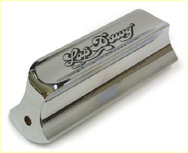
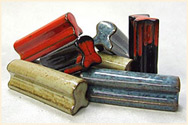
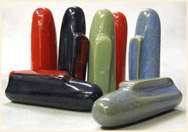
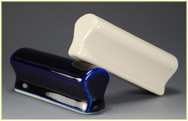
are two main types of bar, or "steel", for playing "lap-style", It really makes sense to amass a good collection of bars, even if you settle on one as a "favourite" it's refreshing to mix it up a bit... A change of tone & feel can be inspirational if you're searching for new ideas or stuck in a rut, even if it means that you still go back to your usual choice. Also,
it makes you a really easy person to buy a gift for! |
No
matter which type of bar you go for, if you're new to playing Steel
Guitar it's a good idea to hold your bar A LOT, to get used to the
feel
of it
in
your
hand. The techniques
for holding each type of bar differ somewhat, so here are some pointers
to get you on your way. |
|||||||||||||||||||
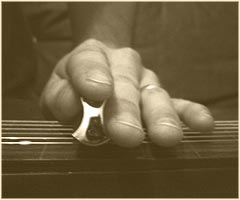
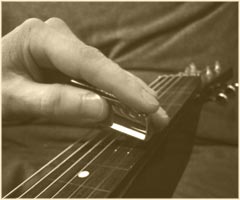
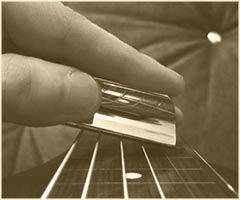
Method for Grooved Bar Grip the bar gently by placing your thumb and middle finger in the grooves on the side of the bar... Rest your index finger along the top of the bar, this helps with accurate control, as you can effectively use your innate "pointing reflex" to target the position of the bar. Use your remaining fingers to rest on the strings behind the bar, to mute unwanted string noise. |
|
||||||||||||||||||
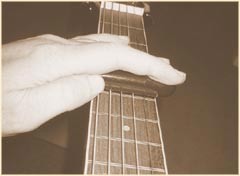
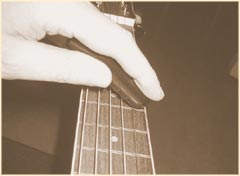
Method for Bullet Bar The method is very similar to holding a grooved bar, except the index finger is more relaxed, applying a little pressure with the fingertip for guidance rather than having it laid flat along the top of the bar. Again the little ("pinky") & ring-fingers are used for behind-the-bar damping. With either bar, the key is to have a relaxed grip! |
|
||||||||||||||||||
Playing Techniques |
|||||||||||||||||||
Open Strings One of the simplest techniques is to draw the bar back towards you, leaving the higher strings to ring "open" ie: unbarred. This easy
method gives access to more varied chordal playing. Sliding
the bar forwards to rebar the higher strings is easier with a bullet-bar's
rounded nose. |
|||||||||||||||||||
Single-string playing & "double-stops" By angling the bar so it's higher at the back (the end closest to you) and just using the tip/"nose" end of the bar, you can play one string at a time. This is easier on the 1st string, on the lower strings be sure to not catch the bar on the string above. If you're crafty & practice well you can bar two adjacent strings without affecting any open strings. |
|
||||||||||||||||||
Bar "blocking" By lifting the bar off the string you can mute or "block" the note, leave your finger/s on the string/s behind the bar so it stops ringing. Just as
importantly this
technique can be used in reverse... |
|||||||||||||||||||
Vibrato This is the technique which is employed to add a "wavering" quality to the pitch of the note being played. With "regular"
acoustic or electric guitar, vibrato is applied by alternately pushing
& pulling a fretted string up & down with a repetetive motion, in
line
with
the
fret. With Steel
Guitar, vibrato is achieved by oscilllating the bar left & right
along the string, thus varying the length ( & pitch ) of the note
being played. There are basically two differing methods of applying vibrato on Steel Guitar, by sliding or rolling the bar. The sliding technique is pretty self-explanatory. The bar is simply slid left & right (or in small circles) at the required speed & amplitude to get the desired effect. Rolling
vibrato is applied by letting the bar rotate using it's contact point
with the strings as a pivot-point. Vibrato is a very personal thing which, along with control of intonation, gives steel guitar it's distinctive vocal-like emotive sound. Playing with no vibrato can sound "dead" and any innacurracy in intonation will show up like a sore thumb... But don't overdo it or use it to hide a lack of correct intonation!
|
To quote Bob Brozman: "The best way to describe how the vibrato motion works is by comparing it to the way you might wiggle a small dish of Jello in somebody's face to make them nervous." | ||||||||||||||||||
Pull-Offs A "Pull-Off" is a note which isn't sounded by plucking the string with the picking hand, but by removing the bar during the previously ringing note. The nature of steel guitar playing means that the note pulled-off to will be an open string... Non-bullet
bar users can
get a snappier, louder sounding pull-off by using the end of the
bar. |
|||||||||||||||||||
Hammer-Ons A "Hammer-On" is a note which isn't sounded by picking, but by having the bar placed with authority onto a still-ringing previous note's string. |
|||||||||||||||||||
Playing Behind the Bar When playing notes where the bar is at one of the open strings harmonic "nodes", (ie: 12th,7th,5th,etc) a "shimmering overtone" effect can be acheived, to hear the full effect pick or strum the string/s behind the bar halfway betwwen the steel & the nut. Ensure that no part of your bar-hand is in contact with the desired string or strings behind the bar. |
|||||||||||||||||||
| Pulling
behind the Bar
Use your left middle finger to pull a string behind the bar to raise the pitch. This technique gives a nice simulation of a pedal-steel guitar sound and can open the door to more complex and varied chords. |
|||||||||||||||||||
Slants Crafty trick to access different chord voicings by placing the bar at an angle to the fret-lines instead of parallel... These can be forward or reverse, using adjacent strings or by crossing strings. This advanced technique is considered easier to perform with a bullet-bar, although Dobro players like Stacy Phillips executes even tricky reverse-slants with a grooved bar. The trick
is to use the tip of your index-finger as the pivot-point. |
Lorene Ruymar demonstrating the correct way to execute slants using a bullet bar, from her video for the schools in Hawaii. |
||||||||||||||||||
|
Bars & Steels |
|||||||||||||||||||
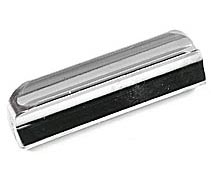
The "Stevens" or grooved steel is easy to hold and as such it's a good bar to get started on.
|
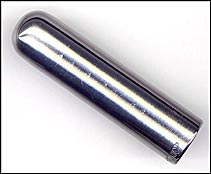
The "Bullet" bar
is a plain cylinder with a rounded tip or "nose".
|
||||||||||||||||||
Material, weight and surface finish all have an influence on tone... Generally speaking the heavier the bar, the more volume and sustain. Common
materials include steel(obviously!) or brass, glass, ceramic or
plastic. The variation of sound resulting from the various properties such as hardness, coefficient of friction etc is highly complex and quite subjective as far as what's most "pleasing"... What's best is to get as many different ones as you can & try 'em out. You may favour one type for a certain song, style/genre or situation. It's more colours for your tonal pallette! They all feel different in the hand & open the ear to the subtle nuances of a guitar's voice. |
The steel bar which gives Steel Guitar it's name has it's origins in the "found object". Various commonly used items were pressed into use, and purpose-made steels were developed from these. Many variations
in timbre and sustain can be achieved through the ingenious use of
found objects, a plastic "Clipper" or "Swan" cigarette lighter being
a good example, for an interesting tone with fast decay.
Bar
diameter |
||||||||||||||||||
Bar Reviews What
constitutes "good
tone" is highly subjective, so there can't
really be such a thing as a "good" or "bad" review... Basically,
everyone's hands & ears are different! Just click on the logos to get to the manufactuers' websites!
|
|||||||||||||||||||