

Intonation |
Intonation is basically the "in-tune-ness" of the note you intend to play. With steel guitars the fret-markers are really only a visual guide & the strings are set high so the fretboard is out of the way of the bar. Unlike a fretted guitar, the pitch of the note is not "set" by a fixed fret, so it's quite easy to play a note "wrong", too high or too low, ie: slightly sharp or flat. This "microtonality" is one of the factors which give these instruments their incredibly vocal-like expressive sound, and easy access to the magical "blue" note... This attribute is shared with many other fretless stringed instruments. The accuracy of the intonation relies on the muscle-memory of the musician, and their ear-to-hand co-ordination. Correct intonation on instruments such as violin, upright (double) bass, cello etc is actually a little easier than on a steel guitar because you always have your thumb in contact with the back of the neck and often have a previously "anchored" finger to refer to, your hand more easily remembers the correct "shape" in order to correctly place the next note. Playing steel guitar is more akin to playing a big "swanny-whistle" left-handed, ie: it relies on arm muscle-memory too, rather than just hand muscle memory. Because of this, accuracy of pitch can be more of a challenge for some, but don't let that put you off! Steel Guitar gives you the ability to glide soulfully into a note from below, wash smoothly from one chord to another, add subtle or wild vibrato or experiment with "exotic" scales.(See Melody section) The ability to effortlessly play "bends" that on a regular guitar would require Herculean forearms and granite fingertips... well, one never gets bored of that! As the strings are quite high it's often difficult to judge where to put the bar to get the note spot-on. Use the fret-lines as a guide but bear in mind that you'll need to compensate for the angle you're viewing it from, rely more on your ears than your eyes! For beginners to get over the intonation "hurdle" just takes a litte practice of a few simple excercises: Play notes
with the bar using an open string as a "referance" tone. |
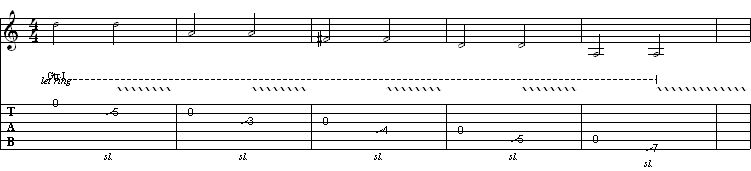
If you're a little flat, adjust the bar calmly and deliberately bridgewards until you're there. If you're sharp, do the same nutwards. Pretty soon your hand-to-ear coordination will improve. As muscle-memory is imprinted the required adjustment becomes less and less, but is still there. Someone with "on-demand" flawless intonation merely makes the adjustment as (& even before) the bar actually comes into contact with the strings. It's
kinda like when you see people who can balance "perfectly" and apparently
motionless on a bike without putting a foot down ( the "trackstand" ). Those adjustments are still there, but have become tiny and anticipatory rather than large & reactionary. The
"wobble" of vibrato can fool the ear into hearing a note as "in tune"...
|
|