

Melody |
The hollowneck
guitar really comes into it's own as a melodic instrument, and is capable
of being used for many different genres.
Posted here should be some things that may help you on your quest to explore the melodic possibilities of the Steel Guitar style...
|
Fretboard Maps can be a useful tool, to aid in learning your way around the fretboard, locating notes on any string, for transcribing or transposing tunes.
|
Commonly
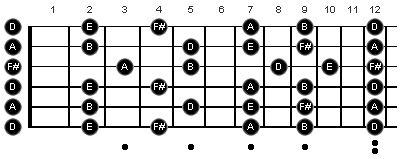
used scale forms can be presented as fretboard "maps" for open D
tuning... D Major
scale D Pentatonic
Major scale D Pentatonic
Minor scale D Pentatonic "Blues" scale Many
licks can be created by using handy "box-shapes" of 2 or 3 note-per-string
patterns... If your improvising try breaking out of a box by unexpectedly running out of the top or bottom of it on a single string. Go on, surprise yourself! These
maps were made using the excellent "LookNoHands" website: A brilliant resource for any style of guitar player, don't be put off by the "Advanced" tag, it's useful for all levels of ability! |
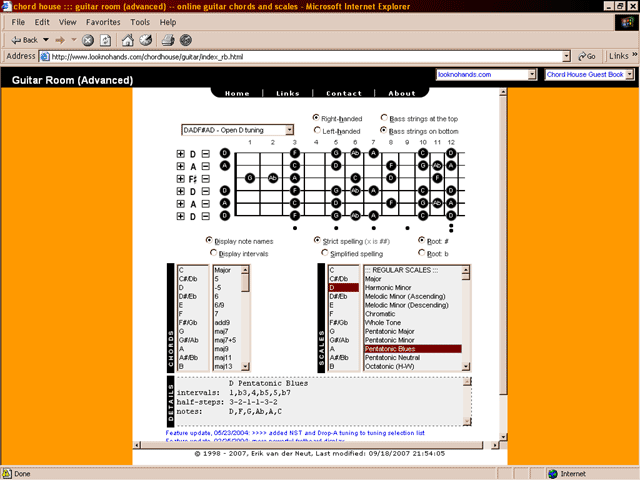
When
you're on the above page you
can set the tuning to any you desire, and display any one of a myriad
of familiar and exotic scales, in any key you like! Print
your own blank fretboard maps, to plot out your own stuff. As the Steel Guitar is truly a microtonal istrument you aren't limited to the 12 note Western scale, so the instrument is well suited to playing music using any of the many "exotic" scales found in music where the octave is divided into more notes. ( Many Eastern scales use 22,24,25 or sometimes even more different pitches. ) Here's
an interesting ( if heavy-going ) paper by Akine Honingh which really
delves into the theory and science behind the relationships between
pitches.
|
Melodic Techniques & Tricks Try
sliding to your target note from above and below, and from different
fret-distances away. See how many notes you can squeeze out of a single strike of a string. If you know a lick or phrase, try finding it on a different position on the fretboard, this will really "open up" the instrument, you'll find the same notes but with different tones. Play
along to vocal-lines or solos on other instruments for inspiration
for phrasing ideas.
|





 The
Origin and Well-Formedness of Tonal Pitch Structures
The
Origin and Well-Formedness of Tonal Pitch Structures